
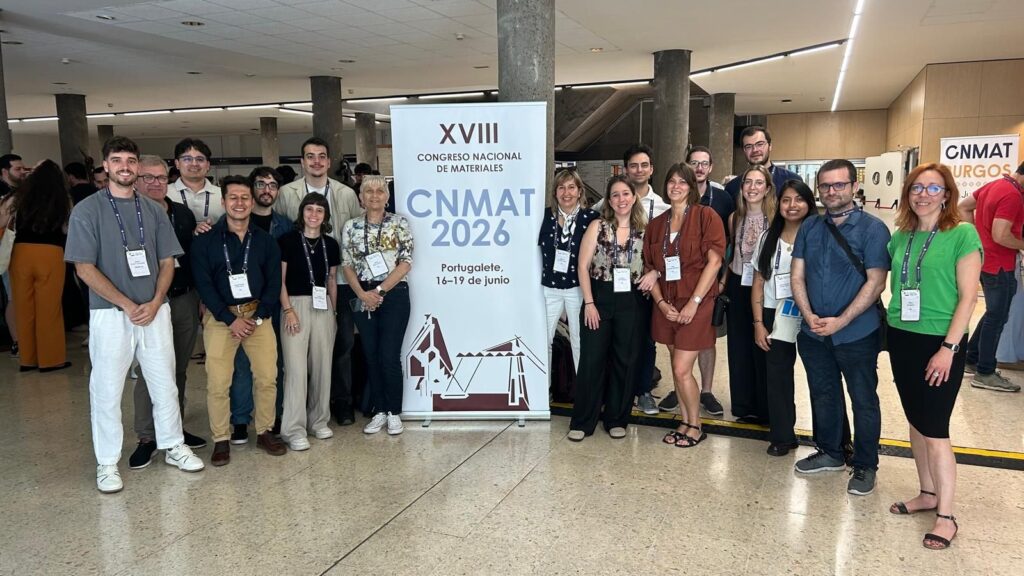
DIOPMA presents its sustainable materials research at CNMAT 2026
The DIOPMA research group at the Universitat de Barcelona participated in the 18th National Congress on Materials (CNMAT 2026),
held from 16 to 19 June in Portugalete, Bizkaia. Its contributions addressed alternative cements, additive manufacturing, biopolymers, thermal energy storage and waste valorisation.
The team’s participation included oral presentations and posters connecting materials design with the evaluation of manufacturing processes, material behaviour and environmental impacts. Two members of the group, PhD student Carlos Vielma Leal and PhD student Sergio Andrés Ardila Parra, received awards for the best oral presentations by young researchers in their respective symposia.
Two awards for DIOPMA’s young researchers
PhD student Carlos Vielma Leal received the award in the Construction Materials Symposium for his research on the prospective life cycle assessment of mechanical clay activation at industrial scale compared with thermal activation. The study compares both approaches through life cycle assessment (LCA), a methodology for evaluating the environmental impacts associated with a product or process. Its prospective approach allows industrial development scenarios to be examined without presenting those projections as the results of an implementation that has already taken place.
PhD student Sergio Andrés Ardila Parra received the award in the Structural Materials and Tribology Symposium. His presentation addressed the creep behaviour of AISI 347H stainless steel in contact with molten salts and a preliminary evaluation of welded joints. Creep is the progressive deformation that a material can undergo under a sustained load, particularly at elevated temperatures.
Alternative cements and the use of secondary resources
Several contributions were part of the alternative cements research area led by Full Professor Josep Maria Chimenos, with Dr Jofre Mañosa co-leading the research on mechanical activation of secondary resources rich in aluminosilicates. These studies investigate raw materials and processes that could contribute to more sustainable construction materials.
Dr Jofre Mañosa presented the scale-up of mechanical clay activation from the laboratory to a pilot plant. PhD student Josep Marco addressed the mechanical activation of kaolin as an alternative to metakaolin in alkali-activated cement formulations. PhD student Adrián Álvarez Coscojuela presented his research on increasing the reactivity of volcanic ash from La Palma through mechanical activation, to investigate its use as a supplementary cementitious material.
Waste valorisation was also the focus of Full Professor Josep Maria Chimenos’s poster on bottom ash from municipal solid waste incineration. The study examines how particle size influences its use as a supplementary cementitious material, employed to partially replace cement in a formulation.
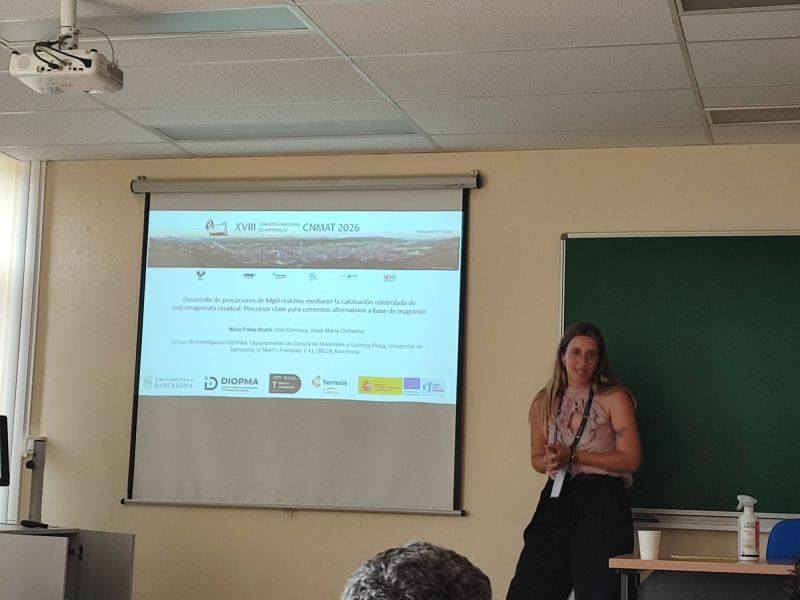
PhD student Núria Freixa Arumí presented the development of reactive magnesium oxide (MgO) precursors through the controlled calcination of waste hydromagnesite, for alternative magnesium-based cements. PhD student Laura Daniela Ochoa Talero addressed the use of mechanically activated water treatment sludge as a cement substitute.
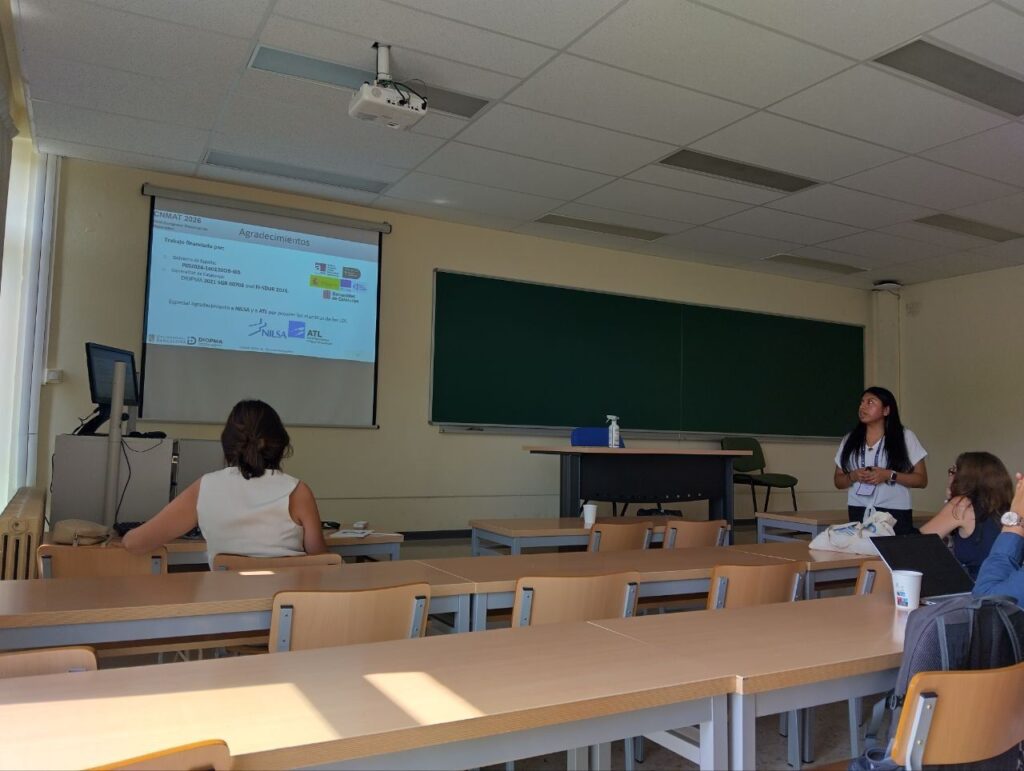
The contributions also included collaborative work on mechanical clay activation with Isabel Santacruz, from the Cement Science Group (CemSciG) at the Universidad de Málaga, and Carlos Blanco de Diego, from the Universidad Carlos III de Madrid.
Additive manufacturing and environmental assessment of processes
Additive manufacturing, or 3D printing, was addressed through formulation development, technology comparisons and the environmental assessment of production processes.
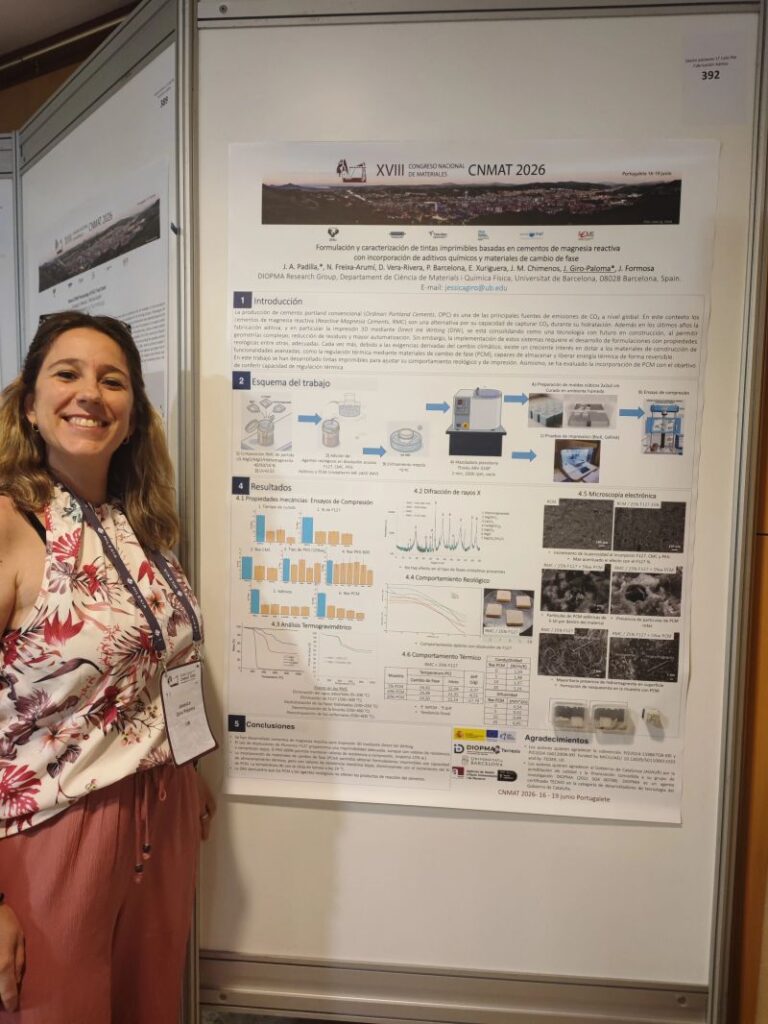
Dr Jessica Giró presented a poster on the formulation and characterisation of printable inks based on reactive magnesia cements, incorporating chemical additives and phase change materials. The study investigates printable construction materials that integrate thermal energy storage, whose behaviour must be assessed alongside their processing properties and strength.
Dr Mònica Martínez presented the environmental assessment and optimisation of additive manufacturing processes for alumina components. Dr Pol Barcelona compared stereolithography with low-pressure injection moulding for the manufacture of dense and porous alumina ceramics. PhD student Mariona Roura evaluated two-component liquid silicone rubbers for 3D printing through Direct Ink Writing (DIW).
Biopolymers and the study of their life cycle
The contributions on polymeric materials examined the relationship between formulation, processing, material properties and behaviour at the end of their useful life.
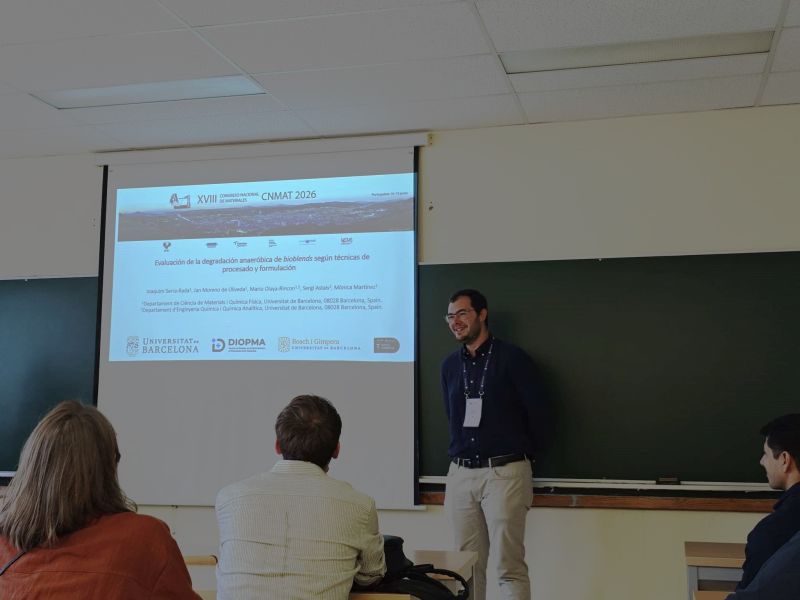
Dr Elena Xuriguera presented a poster on the development and evaluation of PLA and PHA polymer blends, or bioblends, using different processing methods. PhD student Joaquim Serra presented his research on the anaerobic degradation of bioblends according to processing techniques and formulation. The study examines their degradation in the absence of oxygen under the conditions assessed in the research.
Full Professor Mercè Segarra also presented a poster on the life cycle assessment of processing strategies for PLA biocomposites reinforced with bamboo fibres, bringing an environmental perspective to the study of these materials.
Thermal energy storage and tools for materials selection
PhD student Marc Neira presented the design of natural rubber composites incorporating phase change materials (PCMs). These materials store and release thermal energy through a phase transition. The research examines how the structure of the polymer network influences the thermophysical properties of the composite.
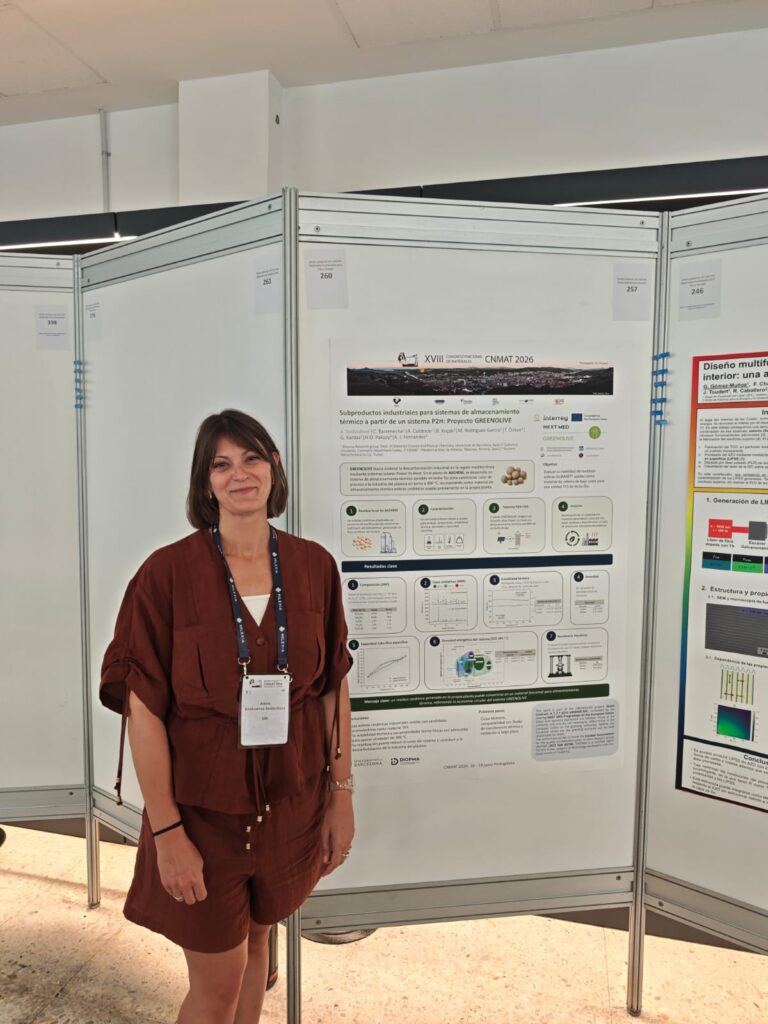
Dr Adela Svobodova presented a poster linked to the GREENOLIVE project on the use of industrial by-products in thermal energy storage systems associated with the conversion of electricity into heat, known as Power-to-Heat (P2H). This contribution forms part of the study of materials for systems that integrate solar energy, electricity-to-heat conversion and heat storage.
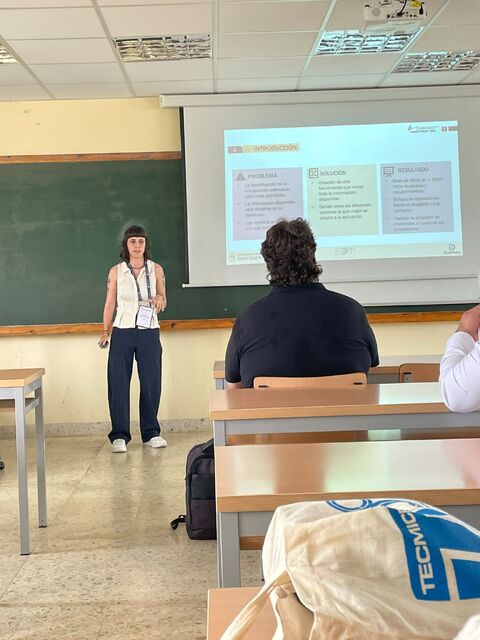
She also delivered a presentation on databases for materials design and selection across different technological contexts, covering PCMs, nanofluids, industrial by-products, emerging materials and high-temperature corrosion.
In this field, PhD student Lorena Betancor introduced a database containing approximately 2,000 high-entropy alloys, both as substrates and coatings. The tool is designed to support materials selection according to their properties and service requirements, with particular relevance to applications where corrosion and wear resistance are key considerations.
Waste valorisation and water treatment
The group’s contributions also included research on resource recovery and the development of materials for environmental applications.
Dr José A. Padilla presented the production of activated biochars from olive stones and their shaping through direct printing, to investigate their application in arsenic removal from acidic waters. PhD student Miquel Subirana addressed the recovery and valorisation of critical materials from aluminium production waste.
Research projects and support
The contributions presented are linked to the following projects and support schemes.
Research projects
| Project | Related research area or contribution |
|---|---|
| PID2021-125810OB-C21 | Research on alternative cements and construction materials. |
| PID2024-160120OB-I00 | Alternative cements, mechanical activation of secondary resources and printable reactive magnesia formulations. |
| PID2024-159867OB-I00 | Printable inks based on reactive magnesia cements incorporating phase change materials. |
| PID2022-139828OB-C21 | Research on bioblends, additive manufacturing and life cycle assessment. |
| GREENOLIVE | Industrial by-products for thermal energy storage associated with Power-to-Heat (P2H) conversion. |
The PID projects listed receive Spanish national funding through the Agencia Estatal de Investigación (AEI) and the European Regional Development Fund (ERDF), European Union. GREENOLIVE is funded by the European Union’s Interreg NEXT MED programme.
Grants and accreditation
| Reference | Support or recognition |
|---|---|
| 2021 SGR 00708 | Support for the DIOPMA research group from the Generalitat de Catalunya through AGAUR. |
| 2021 SGR 00512 | Support for the SDT research group, cited in the collaborative work on high-entropy alloys. |
| FI-2022FI_B 00844 | Grant from the Generalitat de Catalunya and AGAUR associated with the doctoral research of PhD student Joaquim Serra. |
| TECNIO | Accreditation of the DIOPMA research group. |
CNMAT 2026 provided an opportunity to share this research with the scientific community and connect materials design, manufacturing and impact assessment. The studies presented address different stages of this process, from characterisation and formulation development to pilot-plant scale-up and the prospective assessment of industrial processes.
Suggested links
- At the first mention of the congress: official CNMAT 2026 website.
- In the awards section: SOCIEMAT’s congress report and list of award recipients.
- At the first mention of GREENOLIVE: GREENOLIVE project page on the DIOPMA website.
- In the relevant sections: link to DIOPMA’s research pages on Construction and Additive Manufacturing.