
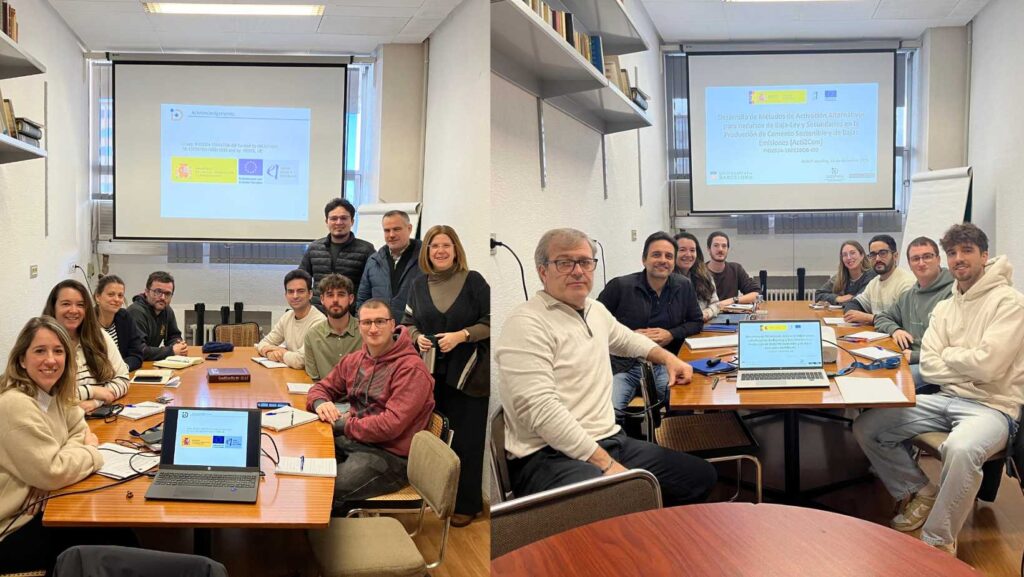
Kick-off meetings of Diopma’s 2026 national plans
A strategic boost to materials science research from DIOPMA
The kick-off meetings for National Plans represent a key milestone in the implementation of strategic projects funded by the Ministry of Science, Innovation and Universities. More than just a formal meeting, these gatherings define the scientific, technical, and organizational roadmap that will guide the execution of high-impact research.
This month, DIOPMA – Disseny i Optimització de Processos i Materials (Design and Optimization of Processes and Materials) – held two kick-off meetings for projects within the Knowledge Generation program, focused on priority challenges in materials science: the decarbonization of cement and advanced thermal energy storage. Both projects reinforce the group’s position in applied research, technology transfer, and industrial sustainability.
In this article, we analyze the scientific and strategic scope of these projects, as well as their contribution to innovation in sustainable materials and advanced energy solutions.
Key points of the article
- Official launch of two projects within the Knowledge Generation program through their respective National Plan kick-off meetings.
- Development of sustainable, low-emission cements from secondary and low-grade resources (Acti2Cem Project).
- Innovative design of phase-change materials (PCMs) for thermal energy storage (INNOVATES Project).
- Integration of circular economy, CO₂ emission reduction, and energy efficiency as cross-cutting themes.
- DIOPMA’s scientific leadership in multidisciplinary research focused on industrial applications.
Project 1: Acti2Cem, alternative activation for a low-carbon cement industry
The Acti2Cem project (PID2024-160120OB-I00) addresses one of the construction sector’s biggest environmental challenges: the high carbon footprint associated with Portland cement production.
New activation routes for sustainable cementitious materials. The research is structured around two main lines:
1. Clay-based materials
Low-energy mechanical and mechanical-thermal activation technologies will be developed for:
- Cements with mineral additions.
- LC3-type ternary cements.
- Alkali-activated cements.
The goal is to reduce clinker content and, therefore, the emissions associated with the conventional process.
2. Magnesium-based materials
The following will be formulated from industrial byproducts:
- Reactive magnesia cements (RMC).
- Hydrated magnesium silicate cements (MSH).
These systems incorporate carbon mineralization processes, contributing to CO₂ capture throughout the material’s life cycle.
Scientific and Industrial Impact
Acti2Cem combines advanced characterization, process optimization, and eco-efficiency assessment to ensure competitive technical performance. The integration of secondary resources and low-grade materials aligns with the principles of the circular economy and the Sustainable Development Goals.
Project 2: INNOVATES, advanced design of phase change materials for thermal storage
The INNOVATES project (PID2024-159867OB-I00) focuses on the innovative design of phase-change materials (PCMs) for thermal energy storage (TES), a key technology for the efficient integration of renewable energies.
New PCM Families for Specific Applications
The project includes the development of different types of materials:
- Shape-stabilized PCMs
- Incorporated into elastomeric matrices, such as natural rubber, these will allow for the adjustment of melting temperatures for applications such as:
- Power generation.
- Hot water production.
- Thermal comfort in buildings.
- Battery thermal management.
- Microencapsulated PCMs (MPCMs)
Recycled materials will be used in the encapsulation to guarantee:
- Chemical resistance.
- Physical and mechanical stability.
- Compatibility with construction environments.
These MPCMs will also be integrated with alternative cements for non-structural applications, generating innovative hybrid solutions.
Solid-to-solid PCMs based on hybrid perovskites (LHOIPs)
Thermal modulation strategies will be investigated using:
- Incorporation of nanoparticles.
- Variation in the length of organic chains.
The objective is to optimize the temperature and enthalpy of transition without liquid-to-solid phase changes, improving stability and durability.
Experimental validation and modeling
The project (September 1, 2025–August 30, 2028) will combine:
- Advanced experimental characterization.
- Development of laboratory-scale prototypes.
- Thermal modeling.
- Environmental impact assessment.
Conclusions on the kick-off meetings of the 2026 national plans
The kick-off meetings for the National Plans held by DIOPMA mark the beginning of two strategic research projects with a direct impact on industrial decarbonization and the energy transition.
On the one hand, Acti2Cem contributes to redefining the paradigm of cementitious materials through alternative activation and carbon capture technologies. On the other, INNOVATES drives the development of advanced thermal storage solutions based on next-generation phase-change materials.
Both projects reflect a clear commitment to innovation in materials science geared toward real-world applications, with a comprehensive approach that combines sustainability, technical performance, and knowledge transfer to industry.