
DIOPMA presents its thermal energy storage research at Eurotherm 2026
The DIOPMA research group at the Universitat de Barcelona participated in Eurotherm Seminar No. 119, held from 13 to 15 May 2026 at the Universitat de Lleida. Organised by the GREiA research group, the event focused on the contribution of thermal energy storage to decarbonisation and brought together researchers and professionals from academia and industry.
DIOPMA’s participation included four oral presentations and two posters on phase change materials, waste valorisation, thermal energy storage and the behaviour of materials at high temperatures. The group also presented the European GREENOLIVE project and its proposed solar-driven solutions for industrial decarbonisation in the Mediterranean region.
Phase change materials and waste utilisation
One of the research areas presented focused on phase change materials, commonly known as PCMs. These materials store and release thermal energy through a phase transition. Their composition and integration into other materials influence the behaviour of the resulting system.
Marc Neira Viñas presented a poster on shape-stabilised PCMs incorporating a cross-linked natural rubber matrix. The study examines how the structure of the polymer network influences the incorporation of the phase change material and its thermal properties.
David Vera Rivera delivered an oral presentation on the conditions for PCM microencapsulation using post-consumer polymethyl methacrylate (PMMA) waste. The research investigates a solvent evaporation process and explores the use of this waste to prepare microcapsules for thermal energy storage.
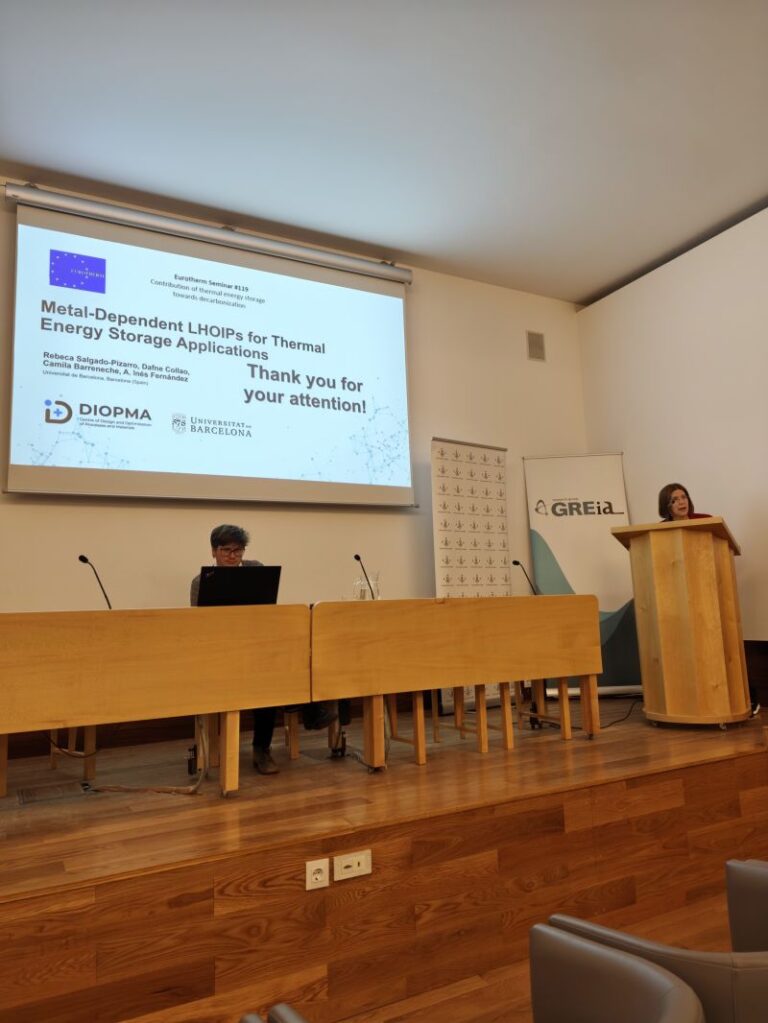
Inés Fernández also presented Rebeca Salgado-Pizarro’s research on LHOIP compounds containing different divalent metals for thermal energy storage through solid–solid transitions. Among the compounds investigated, the zinc-based compound stood out for its storage capacity and thermal stability. These findings apply to the materials and conditions assessed in the study.
Corrosion and mechanical behaviour at high temperatures
High-temperature thermal energy storage requires research into both the materials that store energy and those that must withstand the system’s operating conditions. Interactions with molten salts and the mechanical response of components were the focus of two further DIOPMA contributions.
Camila Barreneche presented Lorena Betancor Cazorla’s research on protective coatings exposed to molten chloride salts for concentrated solar power (CSP) applications. The study evaluated the corrosion resistance of coatings applied using the HVOF technique, including Inconel 625.
Inés Fernández also presented Sergio Andrés Ardila Parra’s poster on the creep behaviour of AISI 347H stainless steel in contact with molten nitrate salts at high temperatures. Creep is the progressive deformation that a material can undergo under a sustained load, particularly at elevated temperatures. Investigating this behaviour helps assess the mechanical response of materials intended for these service conditions.
GREENOLIVE and thermal energy storage for industry
The GREENOLIVE contribution addressed the evaluation of an industrial silica-based ceramic filler for a packed-bed thermal energy storage unit. In this configuration, the solid material serves as the heat storage medium.
Inés Fernández delivered this oral presentation as a case study from the GREENOLIVE pilot, which combines solar energy, Power-to-Heat (P2H) conversion and thermal energy storage. The research focuses on evaluating the material within this technological approach.
She also presented GREENOLIVE’s objectives during the Europe’s Corner session, dedicated to European thermal energy storage research projects. The project aims to contribute to the decarbonisation of industries in the Mediterranean region through solar-driven solutions.
Dissemination activities were carried out during the event alongside Cristina Prieto Rios from Build to Zero, an associated partner of GREENOLIVE. Results from work package WP3 were also shared, contributing to discussions on the challenges of scaling up thermal energy storage technologies.
DIOPMA’s contributions addressed different research scales, from material composition and characterisation to evaluation in storage systems. The event provided an opportunity to share this research with the international community and discuss the challenges of developing it for energy applications.
Post links
- At the first mention of GREENOLIVE: GREENOLIVE project page on the DIOPMA website.
- For additional context: news article on the launch of GREENOLIVE.
- At the mention of the event: official Eurotherm Seminar No. 119 website.