
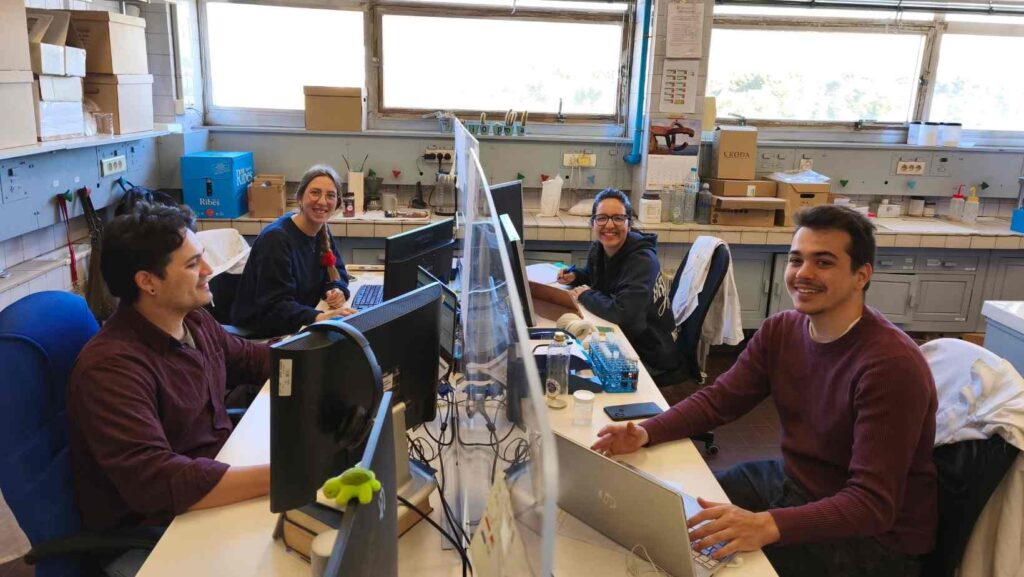
DIOPMA begins the second semester of the 2025/2026 academic year with more than 50 students promoting research in materials science
The new spring 2025-2026 academic semester has begun with great energy at the DIOPMA research group. Laboratories, offices, and workspaces are once again buzzing with research activity thanks to the addition of more than fifty students from various stages of their studies who are actively participating in projects related to materials science, energy, and sustainability.
This start to the semester reinforces DIOPMA’s role as a multidisciplinary research environment closely connected to industry, technological innovation, and the training of new generations of scientists and engineers. Doctoral students, master’s students, and undergraduate students share spaces and lines of research aimed at addressing high-impact scientific and technological challenges.
In this context, research training becomes a key element for generating applicable knowledge, fostering technology transfer, and driving the development of advanced materials with real-world applications in diverse industrial and social sectors.
Lessons learned from the start of this semester at DIOPMA
The start of the Spring 2025-2026 semester is accompanied by intense research activity, new academic additions, and projects related to advanced materials, sustainability, and energy. These are some of the highlights of this new phase at DIOPMA.
1. A Growing Research Community
The lines of research developed in DIOPMA’s laboratories address strategic areas such as:
Additive manufacturing
Thermal energy storage
Environment
Alternative building materials
Emerging technologies related to materials and energy
This approach allows us to combine fundamental research with real-world industrial applications, aligned with current challenges in sustainability, energy efficiency, and technological innovation.
2. Research focused on scientific and industrial challenges
The lines of research developed in the DIOPMA laboratories address strategic areas such as:
- Additive manufacturing
- Thermal energy storage
- Environment
- Alternative building materials
- Emerging technologies related to materials and energy
This approach allows for the combination of fundamental research with real-world industrial applications, aligned with current challenges in sustainability, energy efficiency, and technological innovation.
3. Practical training in highly specialized environments
Student participation in active research projects facilitates direct contact with advanced experimental methodologies, specialized scientific equipment, and the work dynamics typical of a professional research environment.
Furthermore, this experience contributes to the development of essential technical and transversal skills for their future scientific or industrial careers.
DIOPMA PhD Students: Driving Materials Science Research
Currently, 19 PhD students are conducting their research within the DIOPMA group, working in five strategic areas that represent some of today’s major scientific and technological challenges.
Among these areas, additive manufacturing stands out as a key technology for producing advanced components with complex geometries and optimizing resources. This area has great potential in sectors such as engineering, energy, and construction.
Research in thermal energy storage is also of paramount importance, an essential field for improving energy efficiency and facilitating the integration of renewable sources into industrial and urban systems.
In parallel, projects related to the environment and sustainable materials allow for the exploration of new solutions to reduce the environmental impact of conventional processes and materials. These areas include the study of alternative materials for construction and technologies geared towards a more circular and efficient economy.
The coexistence of different research areas within the group fosters interdisciplinarity and the generation of knowledge applicable to a wide range of industrial sectors.
Master’s Students Strengthen the Connection Between Training and Advanced Research
The presence of master’s students in DIOPMA’s laboratories continues to solidify as a strategic element within the group’s activities.
This semester, 10 students from the University of Barcelona’s Master’s program in Renewable Energies and Energy Sustainability (MERSE) are conducting their research in the group’s laboratories, collaborating directly with faculty and researchers on projects related to energy sustainability, functional materials, and emerging technologies.
In addition, a student from the Master’s program in Nanoscience and Nanotechnology is completing their Master’s Thesis within the group, delving into high-value-added technologies linked to the nanoscale and new applications of advanced materials.
The incorporation of these students helps strengthen the connection between specialized training and applied research, a fundamental aspect for transferring knowledge to industry and generating scientific innovation with real-world impact.
Energy sustainability projects and advanced materials
International and Interdisciplinary Training
The master’s programs linked to DIOPMA integrate students with diverse backgrounds, enriching the research environment and fostering multidisciplinary collaboration.
This context allows for addressing complex scientific problems from complementary perspectives, combining knowledge of chemistry, physics, engineering, and sustainability.
Scientific and Industrial Impact
The training of undergraduate students continues to be one of the fundamental pillars of DIOPMA’s academic and research activity.
This semester, a total of 19 undergraduate students from the University of Barcelona are developing their Final Degree Projects (TFG) in the group’s laboratories.
Of these, 12 students from the Bachelor’s Degree in Materials Engineering are working on experimental projects related to the characterization, development, and application of new materials.
At the same time, 6 students from the Bachelor’s Degree in Chemistry are participating in research lines related to materials and sustainability, contributing to experiments and studies aimed at understanding properties, processes, and technological applications.
Finally, a student from the Chemical Engineering degree program is completing their final degree project within the group, reinforcing the interdisciplinary nature of the projects developed at DIOPMA.
These experiences allow students to gain direct contact with real-world research in highly specialized environments, participating in scientific teams and acquiring practical experience in advanced methodologies.
A Semester Boosting Scientific Talent
The start of the Spring 2025-2026 semester reflects DIOPMA’s sustained growth as a leading research group in materials science and energy sustainability.
The addition of doctoral students, master’s students, and undergraduate students strengthens not only the group’s research capacity but also its commitment to scientific training, technology transfer, and the generation of knowledge with social and industrial impact.
This academic and research ecosystem fosters synergies between disciplines, drives innovation, and contributes to the development of technologies and materials geared toward the challenges of the future.
In a global context marked by the need for sustainable solutions and more efficient processes, training new researchers becomes a strategic commitment to advancing toward a more competitive, responsible, and technologically advanced industry.