The European Commission defined six Key Enabling Technologies (micro and nanoelectronics, nanotechnology, industrial biotechnology, advanced materials, photonics, and advanced manufacturing technologies) to modernise and increase Europe’s industrial base. These six technologies should be the shift to develop new knowledge and tools to face the main challenges of European society for the following years.
The impact and use of additive manufacturing have increased in recent years due to its vast potential. Additive manufacturing has been defined as a critical technology in the Factories of the Future (FoF) roadmap (H2020 program). This technology will allow manufacturing with improved features to increase the productivity and efficiency of the industrial sector. Therefore, the NET3D+coordinated project is aligned with the EU’s primary strategy and research priorities. This project’s main objective is to develop new hybrid multi-material additive technology to obtain parts with improved performances and high-value products through Direct Ink Writing (DIW) or Digital Light Processing (DLP) systems.
To reach this primary purpose, this multidisciplinary research project will focus on the unlimited geometric constraints provided by AM, optimisation processes based on the finite element method and the development of printable inks of different advanced materials. In the first step, common materials used in additive manufacturing, such as photosensitive resins, will be reinforced by introducing several micro-nanoparticles and fibres. Consequently, advanced printable materials with improved properties will be obtained. Therefore, several printable inks will be developed and formulated to be used and validated in a DLP 3D printing system, which uses light to cure photosensitive inks.
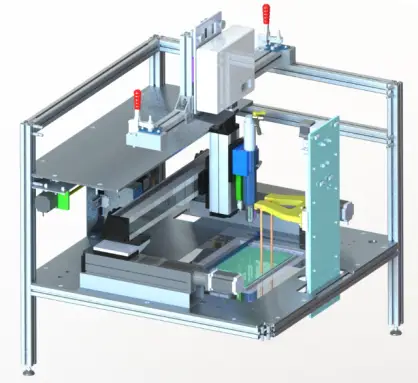
In a second step, a multi-material Direct Ink Writing technology with a coupled light emission system will be developed to print inks made of different materials (polymers, metals, ceramics and composites). The developed inks will be based on photosensitive resins or polymers, and their formulations will change in function of the device requirements and the combination of materials. Several cases and industrial applications will be studied and analysed, such as reinforced biomaterials to obtain regenerative tissue scaffolds, micro-nanoporous structures made of titanium oxide with high catalytic activity, chill permanent moulds for casting process, printed microelectronics for sensors and radiofrequency, etc.
In parallel, the macroscopic and microscopic characterisation of the physical and chemical properties of the different printable inks obtained will be done to optimise the printing parameters and the subsequent processes to get suitable materials with the desired geometry in function of the final application.
Finally, the improved material constitutive relations will be defined to develop a geometrical optimisation process of the manufactured parts through finite element analysis.
The DIOPMA center of the University of Barcelona participates in the NET3D+ project in subproject 3 (DPI2016-80119-C3-3-R).